Tungsten and Building the West's Next Critical Mineral Supply Chain
Recent Articles
Author: Kurtis Yan
06/24/2026
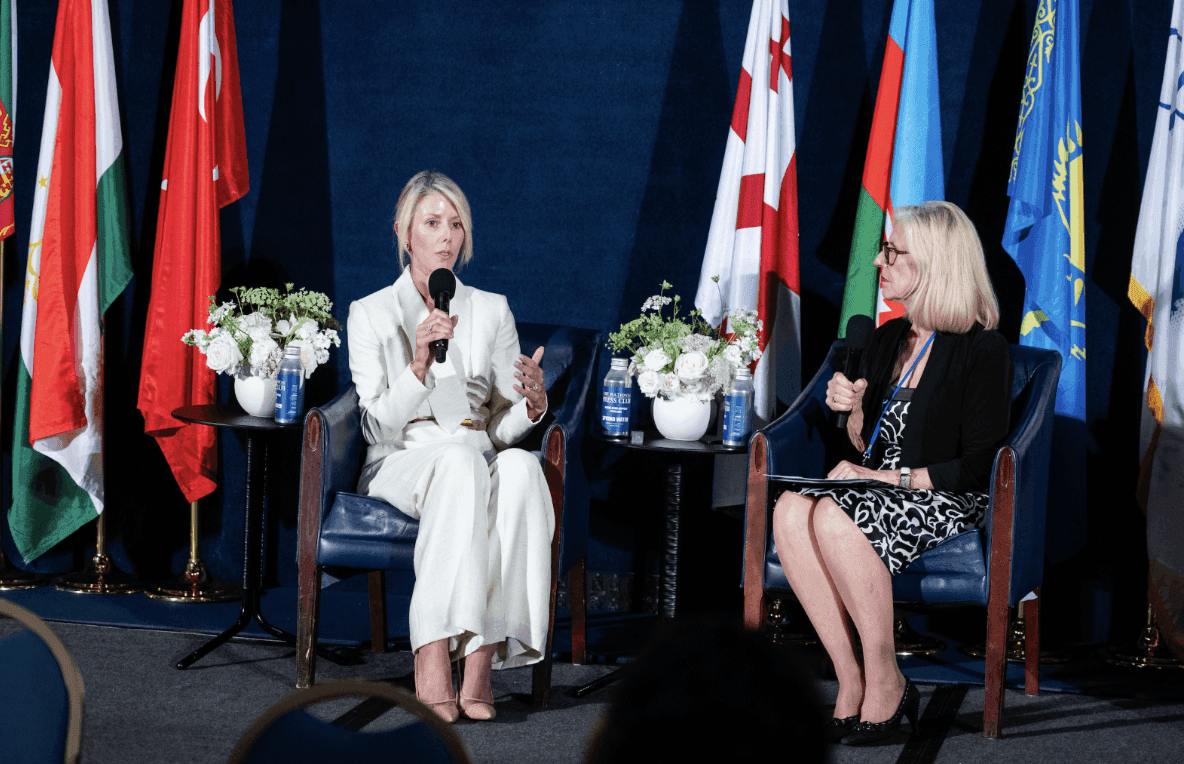
A country’s critical-mineral supply chains, from mine to market, might well define its energy security and national defense for years to come. As the United States seeks to secure access to needed mineral supplies for the future, momentum is growing for Central Asia to take a key place in Washington’s calculus. More broadly, minerals can spearhead the region’s expanded diplomacy and economic cooperation with Europe. and the United States This was the primary message of “Critical Minerals: Capitalizing on the Momentum”—the third panel at the Caspian Policy Center’s 10th Anniversary Trans-Caspian Forum 2026.
The June 10 event at the National Press Club in Washington brought together an array of policymakers and industry experts. CPC Advisory Board Member Dr. Marsha McGraw Olive discussed prospects for the critical-minerals industry with the Head of Global Engagement for the highest profile mining project in the region, Ashley Beaty of Cove Kaz Capital Group. Beaty spoke on the origins of her company’s engagement in Kazakhstan, anticipated production timelines, and how Western companies can follow suit. Cove Capital’s tungsten deal with Tau-Ken Samruk is the region’s latest yet most crucial example of U.S. involvement in the sector, symbolizing a wave of newfound interest in Central Asia’s mineral potential.
Adapting to Market Dynamics
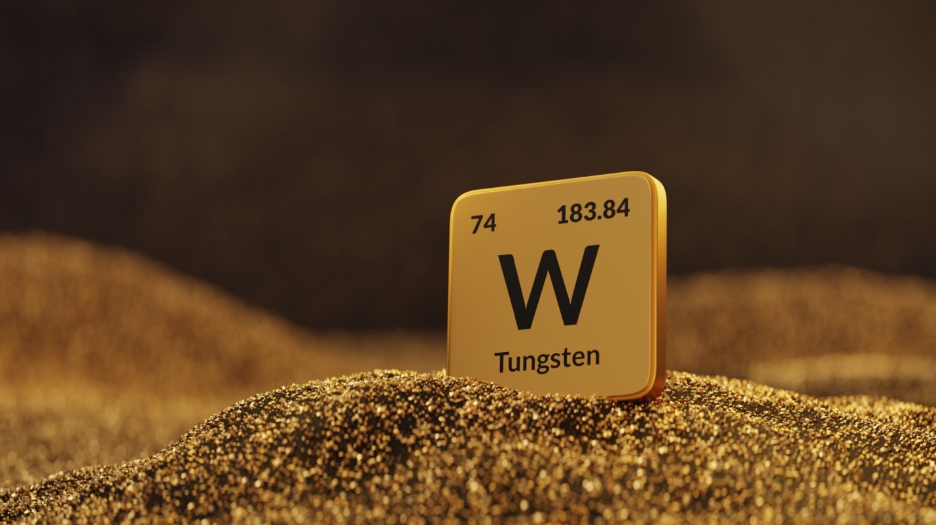
Dr. McGraw Olive and Beaty both highlighted that the global market for tungsten has faced unprecedented instability due to geopolitical crises and increasing demand. Tungsten is used in a diverse range of applications, ranging from munitions systems to aerospace manufacturing and everyday electronics. More significantly, China—which holds the largest global reserves of tungsten at 2.5 million tons—controls most downstream production and implemented export controls on sales of the material in February 2025. These restrictions place strict guidelines on licensing, destination countries, and sales authorizations. As a result, only 15 Chinese firms are permitted to sell tungsten during 2026-2027, and tungsten prices have skyrocketed by roughly 600% since 2025, reaching roughly $3,100 per MTU.
Meanwhile, supplies of tungsten remain scarce compared to global demand. “Demand has easily outstripped supply for the next ten years. Recycling is actually about a third of global production,” said Beaty. She also cited Project Vault, a stockpiling initiative established in February 2026 to meet input demands for investors to develop projects. Thus, much of the new tungsten supply, in the state of ammonium paratungstate (APT), might go toward large-scale refiners in the United States that currently lack offtake to remain operational and satisfy downstream demand.
 Source: Shutterstock
The defense and industrial precedents exist to justify the importance of secure tungsten supplies. Kazakhstan’s Severny (Northern) Katpar and Verkhnee (Upper) Kairakty deposits are anticipated to vault the country to second in global production. Once operations commence, annual supply estimates are expected to hover at 12,000 metric tons.
“Our two tungsten projects in Kazakhstan are estimated, through feasibility studies, at 1.4 million tons of reserve base, so in just these two projects, we anticipate, when both are in production, about 15% of current global supply. That will eclipse Vietnam, which is currently the second largest producer at about 8% of global supply,” stated Beaty.
Attracting Investment and Building Trust
Beaty credited Kazakhstan’s reforms of its mining code as the most important factor that started Cove Capital’s presence in the country in 2022. She pointed primarily to the adoption of Western Australia’s mining standards and internationally recognized arbitration methods for recourse to de-risk mining projects, especially at the early stages of exploration.
“The ability to pursue international arbitration through British Common Law was an essential component for us,” said Beaty. She added that first-come first-serve concessions for greenfield mining sites in Kazakhstan were also attained by Cove Capital in 2023.
Beaty also emphasized the role of mutual trust between Cove Capital and the Kazakhstan government, which guided the company toward the tungsten projects. “We established the business presence and the trust with the Kazakh government, and that is how we were invited to the tender process to compete on the privatization of Severny Katpar, which is two tungsten deposits owned by the national mining company—Tau-Ken Samruk,” she explained.
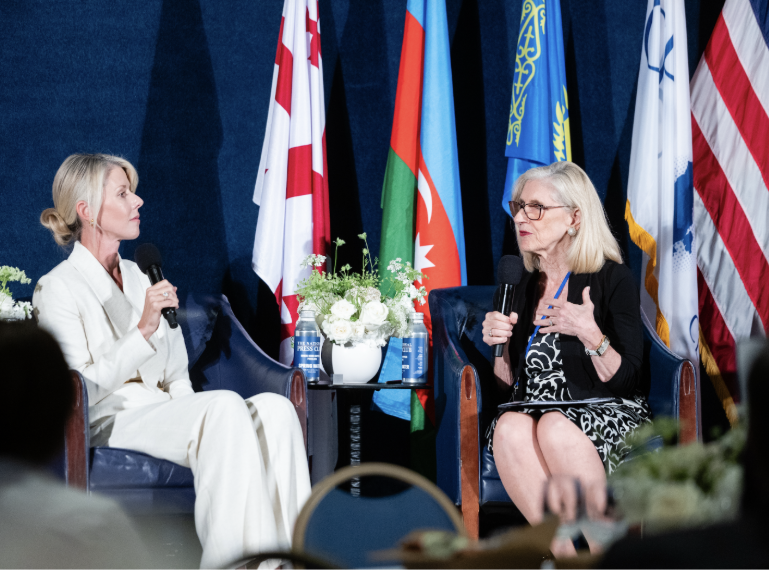 Dr. Marsha McGraw Olive (right) speaking with Ashley Beaty (left) at the Trans-Caspian Forum
Dr. McGraw Olive raised the question of working under ESG (Environmental, Social, and Governance) standards in Kazakhstan, stating, “American investment brings with it some important values for international standards for items such as the environment and the criticality of water and energy.” Beaty reaffirmed this commitment, pointing to the importance of water reclamation and ensuring that local communities do not face negative environmental impacts from mining projects.
“Even our own mining team is pleased with the rigor that the Kazakhstanis are holding us to account to, and it is our responsibility. It’s a 70/30 joint venture. We are bringing the financing, the operational management, and the offtake, but it has really great oversight by the national mining company of Kazakhstan,” said Beaty.
She added that permitting processes for environmental standards will take place this year. Along with permitting, Cove Capital will begin a definitive feasibility study later this year, which occurs 18 months before mine construction. Beaty mentioned that the Cove Capital team working in Kazakhstan is the same team that helped develop the Nui Phao tungsten mine in Vietnam.
Indicators for U.S.-Central Asia Cooperation Going Forward
U.S. investor interest is growing in the region. To support private investment, government financing tools need to continue to play an active role. The U.S. International Development Finance Corporation (DFC), along with the U.S. Export-Import (EXIM) Bank, both issued letters of interest (LOI) for the Cove Capital tungsten project, amassing to $1.6B in government support.
The 2026 Astana Mining & Metallurgy Congress in Astana, June 10-11, was a clear example of this momentum. Representatives from Cove Capital were in attendance, as well as U.S. officials from the Department of Commerce, DFC, and EXIM Bank. Moreover, Kazakhstan’s Prime Minister Olzhas Bektenov stated that the country aims to become a processing hub, both for domestic raw inputs and for materials from the broader region.
To achieve this goal, Central Asia must position itself as a more attractive business environment. Building investor confidence entails quelling skepticism and doubts, including those surrounding logistical corridors. Beaty reassured that the tungsten project will have access to railways and other essential infrastructure. However, she also remarked that rail is essential in the region for building additional capacity for other Western companies.
As such, the integration of Central Asian minerals into Western markets will require facilitating public-private partnerships, streamlining the Middle Corridor, assessing any resource constraints, and making calculated decisions on the location of processing facilities. The Trans-Caspian Forum clearly demonstrated that U.S. investors intend to capitalize on Cove Capital’s initial breakthrough. To turn intent into reality, panel discussions concluded that the Central Asian governments, Washington, and the U.S. private sector must all take the proper steps to finance projects, build industrial capacity, and promote fruitful business.