The Baku Energy Pivot: Why Azerbaijan Matters More Than Ever to Europe and the United States
Recent Articles
Author: Kurtis Yan, Lilly Horrigan
06/05/2026
 Official Website of the President of the Republic of Azerbaijan
Record high-level engagement on the main stage and sidelines of Azerbaijan’s premier annual energy forum highlighted the growing group of corporations and state actors looking to deepen involvement in the Greater Caspian region. The Baku Energy Week, June 2-3, brought together regional and global energy leaders as well as industrial investors for strategic discussions and the signing of 20 new agreements worth $7.5 billion. Azerbaijan’s President Ilham Aliyev kicked off the forum by emphasizing his country’s growing importance in global energy markets and in the development of renewable energy. In tandem with the international forum, a U.S. delegation arrived for the first-ever U.S.-Azerbaijan Economic Dialogue. The week-long forum highlighted Azerbaijan’s expanding role in achieving critical regional connectivity goals and deepening economic cooperation with Western markets.
Energy Week Attendees and President Aliyev’s Opening Remarks
Much like in previous years, this year’s Baku Energy Week brought an array of high-level foreign companies to Azerbaijan’s capital. The most notable attendees were foreign gas and oil corporations, including Exxon, BP, Chevron, TotalEnergies, and Shell. Many of the companies have already established ventures and partnerships with regional entities like the State Oil Company of the Republic of Azerbaijan (SOCAR) and BOTAS—Türkiye's state petroleum company. Participants also included a U.S. delegation, led by U.S. Assistant Secretary of State for Economic, Energy, and Business Affairs Caleb Orr.
Aliyev’s opening speech provided important insight into the direction of Azerbaijan’s role in global energy markets and future production, stressing the importance of energy diversification for his country’s economic security and resilience. Geopolitical pressures and conflicts, from the Russia-Ukraine War to the U.S.-Iran War, have severely restricted Western access to hydrocarbon resources. In turn, Azerbaijan’s role in supplying European nations with gas and oil is growing, as evidenced by SOCAR’s acquisition of two Italiana Petroli refineries which build Azerbaijan’s downstream penetration into European energy markets. With a number of U.S. and European companies enhancing involvement in the Greater Caspian Region, Azerbaijan and its state energy entities have demonstrated the ability to continue exercising influence in interregional hydrocarbons trade.
Azerbaijan’s energy future lies in a dual-track approach, explained the President, which expands hydrocarbon energy while developing renewable energy capacities. Moreover, Aliyev underscored the role of renewable energy sources, not only for meeting domestic energy needs but also for export, despite renewed interest in the South Caucasus and Central Asia for hydrocarbon supplies. For example, Türkiye is partnering with Azerbaijan, Georgia, and Bulgaria to construct an electricity distribution system that incorporates higher output from renewable energy sources. Türkiye aims to invest $30 billion into upgrading its grid infrastructure. Thus, Baku will look to capitalize on overall energy diversification interests to integrate into Western markets and improve East-West diplomacy.
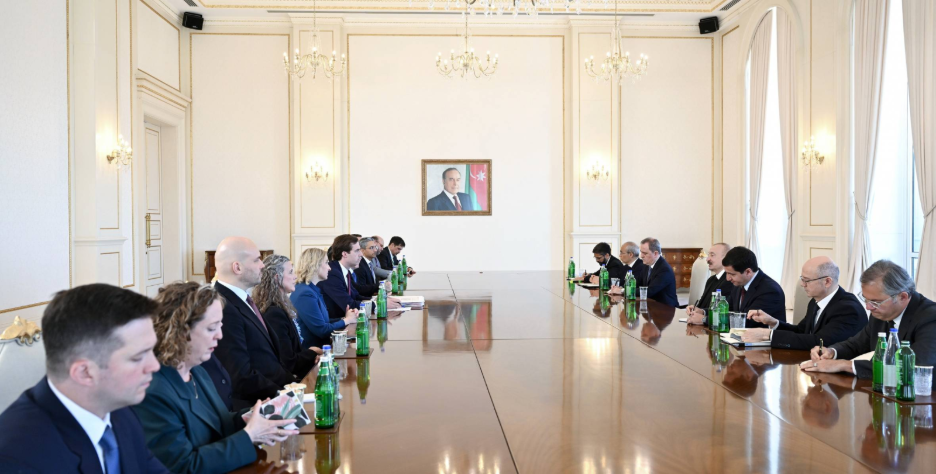
President Ilham Aliyev receives a U.S. delegation led by Caleb Orr, Assistant Secretary of State for Economic, Energy, and Business Affairs. Source: https://president.az/en/articles/view/72634
Azerbaijan-U.S. Economic Dialogue
The first-ever Azerbaijan–U.S. Economic Dialogue took place on June 2 on the sidelines of Baku Energy Week. Organized by the Ministry of Economy of the Republic of Azerbaijan and the U.S. Department of State, the dialogue was led by Azerbaijan's Minister of Economy Mikayil Jabbarov and U.S. Assistant Secretary of State for Economic, Energy, and Business Affairs Caleb Orr, bringing together government officials and private sector representatives to discuss expanding bilateral economic and commercial cooperation. The talks took place under the Strategic Partnership Charter signed during Vice President J.D. Vance's visit to Baku in February.
Officials identified energy investment and regional connectivity as central priorities. Minister Jabbarov highlighted the importance of continued collaboration on transport, logistics, and digital infrastructure to strengthen the Trump Route for International Peace and Prosperity (TRIPP) and the Middle Corridor. Assistant Secretary Orr echoed this, stating that the U.S. expects to help "Azerbaijan grow its role as the central node of the Middle Corridor for energy transit going to Europe and to the rest of the world." He later commented that the U.S. is planning concrete investments in the energy sector, pointing to the continued interest of ExxonMobil and Chevron in the region, with new exploration agreements signed during the week.
The dialogue was significant not only for its focus on energy cooperation, but also for an emphasis on transport, digital connectivity, and supply-chain resilience. Both governments view these areas as essential to the development of the Middle Corridor. The talks also highlighted digitalization’s role in streamlining regional connectivity, featuring panel sessions on artificial intelligence and digital infrastructure.
Baku Energy Week 2026 Deals
On the sidelines of Baku Energy Week, SOCAR, France's TotalEnergies, ADNOC's international gas subsidiary XRG, and Türkiye's BOTAS signed a new 15-year agreement for the purchase of natural gas from Azerbaijan's Absheron field in the Caspian Sea. The agreement outlines terms for the sale of 33 billion cubic meters (bcm) of gas to Türkiye via the Baku-Tbilisi-Erzurum pipeline at a rate of 2.25 bcm per year, starting in 2029. This long-term agreement reinforces the viability of the Southern Gas Corridor at a moment when Europe is making a concerted effort to reduce Russian gas dependency. It also demonstrates the continuing view of Azerbaijan among investors as a long-term and stable energy partner.
The original development agreement for Absheron was signed in 2009 between TotalEnergies and SOCAR, each holding a 50% stake in the project. ADNOC later joined the consortium in August 2023, with each of the original partners reducing their share to 35% and ADNOC holding the remaining 30%. The first phase of development began in July 2023, producing around 4.2 million cubic meters of gas per day and 12,800 barrels of condensate. A final investment decision on Phase 2 is expected in July of this year, with construction to begin in 2027 and production targets of over 4 bcm annually by 2029. Despite the maturity of many of Azerbaijan’s existing oil fields, the deal signed during Baku Energy Week signals an investor consensus in the Caspian basin’s continuing potential and underwrites the investment case for Phase 2. The agreement provides the bankable long-term commitment the consortium needs to justify the final investment decision expected later this year.
In total, around $8 billion in reported deals were signed at the exhibition and on the sidelines, and SOCAR signed several agreements with European and U.S. oil giants. Primarily, Exxon and SOCAR signed an MoU, under which the parties will explore and develop unconventional oil and gas resources in the Caspian Sea. As many of Azerbaijan’s oil reserves have matured, Exxon can provide the country with technical expertise given its history of extraction and production through fracking. Additionally, SOCAR and Chevron agreed to jointly study the technical feasibility and production potential of Azerbaijan’s portion of the Caspian Basin. SOCAR also signed an MoU with Shell, which asserts that both parties will further cooperate on upstream gas projects, namely in exploration and field development.
Meanwhile, BP will move into the gas recovery and production phase of the Shah Deniz Compression Project. With production expected to begin in 2029, the implementation of an unmanned compression platform at the Shah Deniz fields aims to produce an additional 50 billion cubic meters of gas. BP also acquired access to two new oil blocks in the Caspian Basin. Furthermore, BP will hand over its role as lead operator of the Baku-Tbilisi-Ceyhan (BTC) Pipeline to SOCAR on July 1. BP has maintained operational control over the Azerbaijani and Georgian sections of the BTC since 2006. At 33%, SOCAR owns the largest share, while BP owns 30.1% of the venture.
This transfer of operational responsibility marks a symbolic milestone in Azerbaijan’s energy development. Once dependent on foreign operators to develop and maintain its export infrastructure, Baku is positioning itself as both an energy producer and administrator of regional energy flows that link Caspian to global energy markets. The combination of the first U.S.-Azerbaijan Economic Dialogue, the conclusion of a number of major energy agreements, as well as increased investment into the Southern Gas Corridor demonstrates a clear belief in Washington and Europe that Azerbaijan is now regarded as a key strategic energy nexus that links Central Asia, the South Caucasus and Europe’s markets.