Trans-Caspian Venture: How a Trilateral Gas Deal Could Strengthen East-West Connectivity
Recent Articles
Author: Kurtis Yan
05/14/2026
 SOCAR
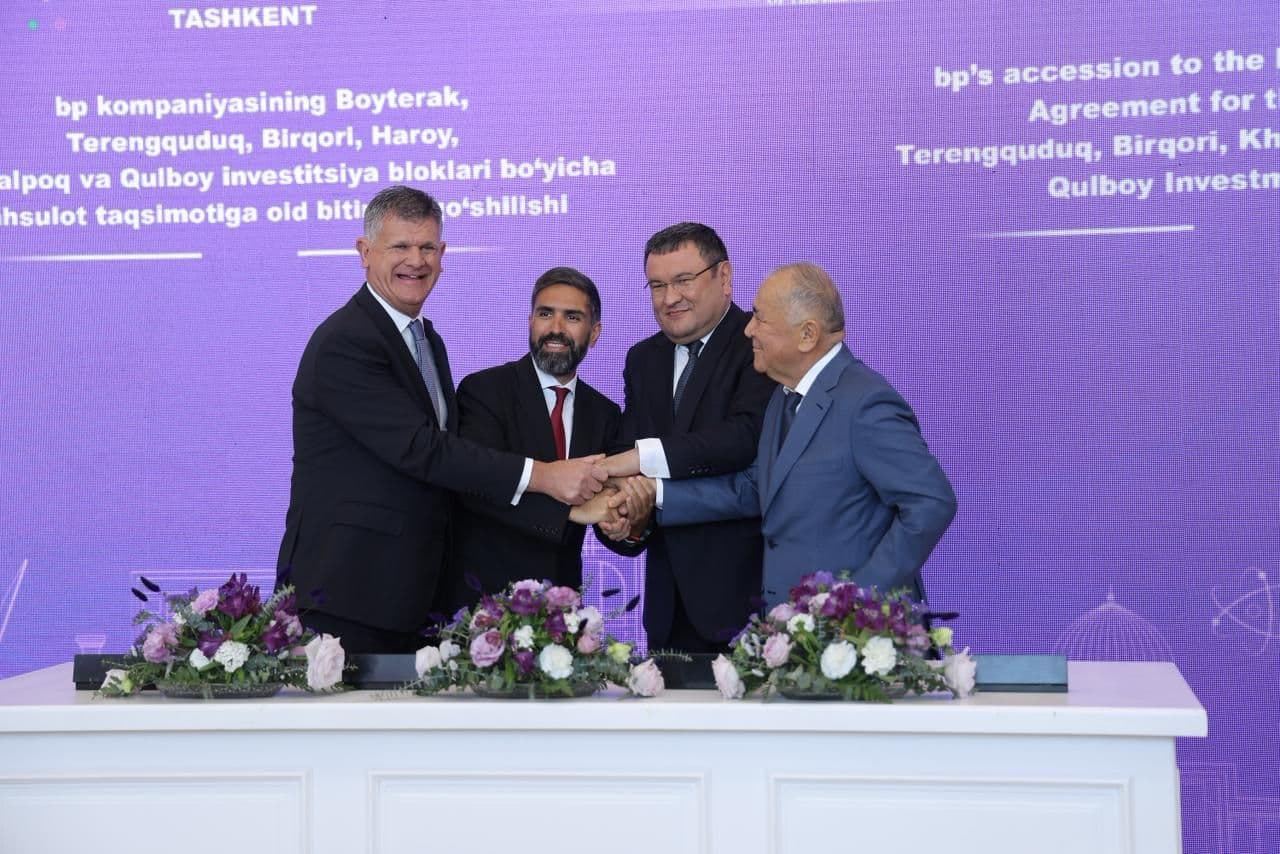
SOCARA new trilateral oil and gas production sharing agreement (PSA) has been signed between BP, SOCAR, and Uzbekneftegaz—the respective national oil and gas companies of Azerbaijan and Uzbekistan. The involved parties announced the deal at this year’s Oil and Gas of Uzbekistan, which took place in Tashkent May 12-14. Under the PSA, exploration will begin at six oil and gas fields in Uzbekistan’s share of the Ustyurt Basin.
The deal serves as yet another example of the changing gas and energy landscape in Central Asia and the South Caucasus. Trans-Caspian cooperation continues to rise as the broader region fields growing interest from foreign companies.
Details of the Deal
Seismic testing has already begun, and exploration will soon begin on the six blocks of the Ustyurt region: Boyterak, Terengquduq, Birqori, Kharoy, Qoraqalpoq, and Qulboy. Uzbekistan estimates that “100 million tons of oil and 35 billion cubic meters of natural gas” can be found in the blocks. The U.S. Geological Survey (USGS) estimates that “2.4 billion barrels of oil and 2.4 trillion cubic feet of gas” might be found in the overall North Ustyurt Basin in Uzbek and Kazakh territory. BP’s involvement in the project can be characterized as a return. It originally signed a deal in 2018 with SOCAR and Uzbekneftegaz to explore the blocks and conduct feasibility assessments. However, it withdrew in 2021 to pivot toward decarbonization ventures, forcing the Ustyurt project to a halt.
To revive the project, a PSA was signed in 2025 by SOCAR, Uzbekneftegaz, and the Uzbek Ministry of Energy. This also led to the creation of an Ustyurt Operating Company field office in Tashkent in December 2025. SOCAR and Uzbekneftegaz had split equity 50/50 before BP’s entrance, though BP’s interest in the Ustyurt project became public in November 2025. Both SOCAR and Uzbekneftegaz now possess 30% equity stakes in the project. BP, meanwhile, will own a 40% stake. However, SOCAR will continue to lead the project as the primary operator and recently announced the opening of a representative office in Uzbekistan.
What the Deal Forecasts for Trans-Caspian Cooperation
For Uzbekistan, its ability to garner foreign interest bodes well for its reputation as an attractive partner and business environment. In recent years, Tashkent’s concern has grown over its decreasing gas exports and struggles in upstream oil and gas production. Formerly a net-exporting country, Uzbekistan has since increased its imports of gas. Gas exports dropped by 15% in the first quarter of 2026, and the country purchased about $361 million in gas imports during the same time period. With renewed confidence and foreign investment into its gas sector, Uzbekistan can look to shore up its energy security and further solidify its access to Western energy markets. Moreover, Uzbekistan can now access “BP’s specialized expertise in conventional and unconventional extraction,” stated Dr. Eric Rudenshiold, Research Director and Senior Fellow at the Caspian Policy Center.
Meanwhile, SOCAR’s role in the project as a primary operator signifies real commitment to strengthening Trans-Caspian connectivity. The new representative office in Uzbekistan signals real interest in the success of the Ustyurt venture and in establishing a stronger presence in Central Asia. Azerbaijan already seeks to solidify its logistical importance along the Middle Corridor and as an energy exporter for Europe and the Middle East. In particular, Azerbaijan delivers gas from its fields in the Caspian Sea to Europe through the Southern Gas Corridor (SGC), which consists of multiple pipelines across Türkiye and Greece.
As Central Asia and the South Caucasus aim to bridge gaps in cooperation, the Ustyurt project indicates that Azerbaijan’s role in East-West energy exports will only increase. For foreign investors seeking a partner in the region to strengthen connectivity, the PSA demonstrates Azerbaijan’s significance as a bridge between Central Asia and Western markets. As Dr. Rudenshiold explained, consortiums like the Ustyurt project “serve as catalysts for further engagement and build trust across the Caspian Sea.”
Furthermore, the signing of the new PSA formally marks BP’s first project in Uzbekistan. As BP reorients toward traditional hydrocarbon markets, it might look to pursue further cooperation and investment in the Trans-Caspian region. More importantly, it demonstrates a clear commitment by a Western company to operationalize alternative logistical routes and diversify energy supplies.