2026 Constitutional Referendum in Kazakhstan: Reform, Continuity, and Executive Power
Recent Articles
Author: Zhanel Sabirova
04/09/2026
 shutterstock.com
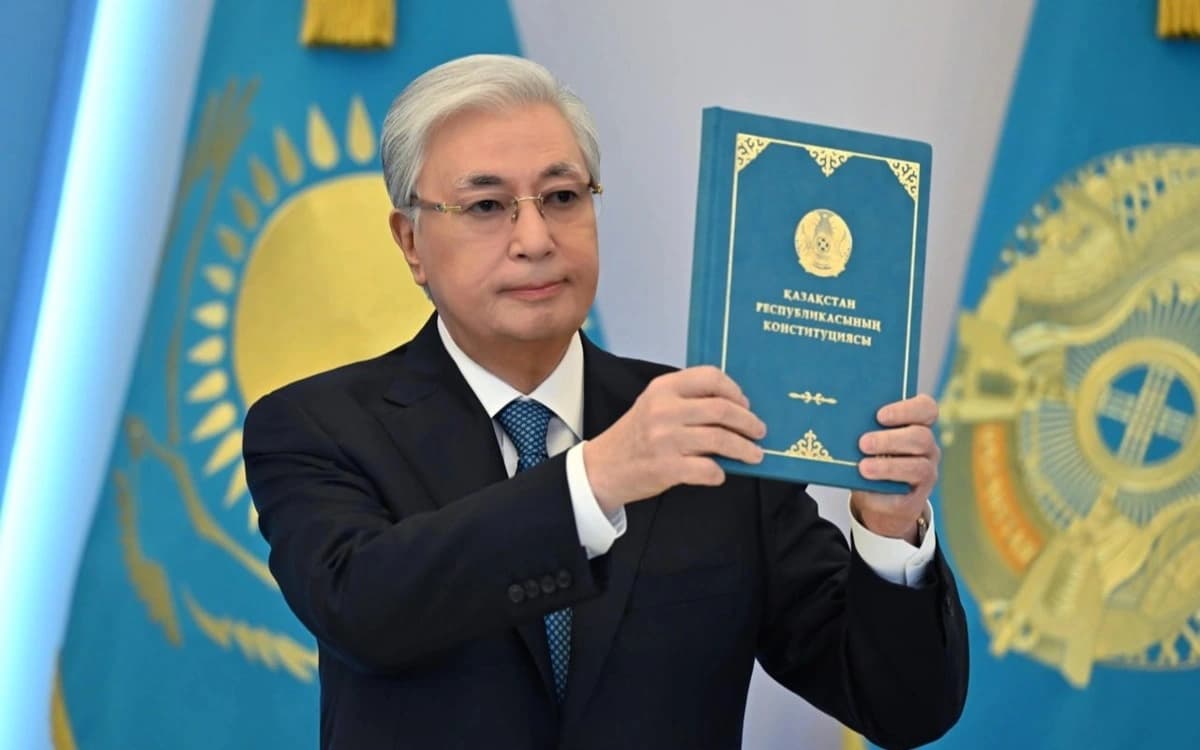
The year, 2026, is shaping up to be a landmark year in Kazakhstan's political evolution. On March 15, the country held a constitutional referendum that concluded in the adoption of a new constitution. Supported by nearly 90% of voters on a turnout of 73%, the referendum marks another considerable transformation of Kazakhstan's legal and institutional foundations. The draft constitution rewrote approximately 84% of the 1995 constitution, introduced 95 articles, and enacted significant structural changes. Among the many changes are the replacement of the bicameral parliament with a unicameral body called the Kurultai and the reintroduction of the office of Vice President. President Kassym-Jomart Tokayev signed a decree officially adopting the new constitution on March 17, with it set to take effect on July 1, 2026, a date that will open a new chapter in the country's post-Soviet political history.
Echoes of the 2022 Constitutional Referendum
The 2026 referendum is Kazakhstan’s fifth since independence and the third such vote since 2022. In March 2022, President Tokayev introduced an ambitious reform program titled, “New Kazakhstan: The Path of Renewal and Modernization,” which culminated in a constitutional referendum on June 5, 2022. The vote amended 33 of the then-constitution's 98 articles, with political commentators assessing that the changes would lessen the influence of the executive branch, grant more powers to parliament, and eliminate the privileges that former President Nursultan Nazarbayev had retained after resigning from office in 2019.
On paper, the changes were significant. These reforms reduced the concentration of presidential power, strengthened parliament, limited presidential terms, eased party registration, expanded the space for independent candidates, and prohibited close relatives of the president from obtaining senior state roles. The reforms were said to transform Kazakhstan from a super-presidential system to a "presidential system with a strong parliament," per Tokayev's own framing in his State-of-the-Nation address. Yet the country continues to face a persistent gap between formal legislation and real implementation.
Some researchers say that the implementation deficit is crucial for understanding why a new constitution was decided to be needed just four years after the 2022 reforms. Many of the 2022 amendments were concessions made to the public, which had been expecting the political system to liberalize. The fact that a wholesale constitutional replacement arrived just two years later speaks volumes about the gap between official assurances and political reality in Kazakhstan.
Adopted Changes of the Institutional Structure of the State
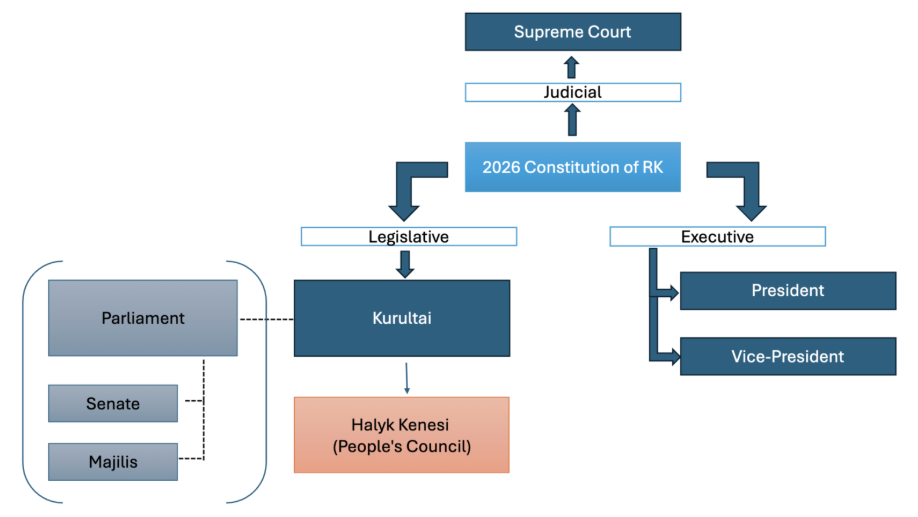
In the new Constitution, 84% of the articles have undergone changes, with the most extensive shifts concerning the legislative branch. Currently, Kazakhstan’s parliament consists of two chambers: the Senate and the Majilis. Under the new constitution, it will be replaced by a unicameral Kurultai, comprising 145 deputies elected to five-year terms exclusively via party lists. As a result, the Senate will cease to exist, and the Kurultai will base its functions on the Majilis. The Kurultai will retain the authority, currently held by the Majilis, to impeach the President, though only if the latter is found guilty of high treason. Overall, the powers of the new parliament have been significantly curtailed. For instance, it will lose the authority to appoint and dismiss many of the country's key officials. Previously, this responsibility was under the authority of the Senate, but with its abolishment, many of functions will now pass to the President. This would seem to signify the return to a more super-presidential system.
Ahead of the 2023 parliamentary elections and after the “Bloody Qantar” large-scale anti-government protests of January 2022, executive control over electoral legislation was loosened. For the first time since 2004, a mixed electoral system was used, with 69 deputies elected from party lists, and the remaining 28 elected in single-mandate districts. It was the first time independent candidates were allowed to participate, resulting in unprecedented competition: about 250 candidates applied to stand for just five seats in the capital of the country, Astana, and in the business capital, Almaty.
However, the new constitution excludes independent candidates from being elected to Parliament, or to the Kurultai now, and electing parties are not obliged to submit open lists of candidates. This style of system canhttps://eurasianet.org/kazakhstan-ruling-party-dominates-single-mandate-races diminish the societal representation in the legislative branch and allow only party-member candidates. The higher threshold for entry likely reduces the pool of eligible and viable candidates. Notably, independently elected candidates could help reflect a wider spectrum of societal perspectives, serving as a modest counterbalance to the pro-presidential parties like “Amanat” (formerly “Nur Otan”).
Presidential influence will be seen further in the appointment of the new governing bodies and their members, reminiscent of executive powers in the 1995 constitution. The Halyk Kenesi (People's Council) will be established as a new advisory institution in the country. It will possess the right of legislative initiative and be empowered to introduce bills to parliament. Unlike the Kurultai, for which elections will be held, all 164 members of the People's Council are to be personally appointed by the President.
More in the list of newly created state bodies, the most significant innovation regarding the executive branch is the reinstatement of the post of Vice President. The position existed during the early years of Kazakhstan's independence but was abolished in 1995. The Vice President will be appointed by the President and will represent him in interactions with the Kurultai, the Government in general, and other state bodies. However, the primary function of this office lies elsewhere. Whereas under the current Constitution, the President's duties devolve to the Speaker of the Senate in the event of the President’s abdication, illness, or death, the new law stipulates that the powers of the Head of State shall be transferred specifically to the Vice President.
The new requirement also touches upon the eligibility to become Head of State. Now, besides being over the age of 40, the candidate must have at least five years of experience in civil service. Although this might appear logical, it effectively narrows the pool of eligible candidates and structurally favors individuals already embedded within the state system.
The amendments affecting the executive branch indicate an effort to ensure greater predictability in matters of power succession. The new constitution appears grounded in continuing a single-term limit for the presidency as immutable. Although it is unclear whether the adoption of the new constitution will nullify Tokayev’s current seven-year term. Parallel discussions about the end of his tenure as President of the Republic of Kazakhstan suggest a need for a transition mechanism that will ensure stability and predicatbilty.
A noteworthy aspect of the recent constitutional revisions is the removal of the reference to the “checks and balances” term in the article on State Power. This omission is significant, because it leaves the principle more open to interpretation rather than clearly anchoring it in the text of the constitutional. In this sense, the absence of precise wording might allow for a broader and more flexible understanding of institutional constraints and potentially weaken any limits on power as defined and applied in practice.
Domestic Focus and Other Amendments
Language and identity issues are the most domestically sensitive to amendment concerns and have been widely discussed across the country. The new document makes some undefined amendments such as by changing the status of the Russian language from a position of equality or “on par” with Kazakh to one “alongside” the state language. With the assurance from state officials of no negative effect on Russian speakers, the shift is framed as a gradual, non-confrontational decline in the role of Russian. Under the current version of the constitution, officials are required to provide information equally in both Kazakh and Russian. However, under the revised constitutional wording, Russian will be used only upon request by the individual involved in the procedure or application.
A heated debate towards certain interpretations and laws about Kazakhstan’s international human rights obligations has also raised among human rights activists. The Constitution no longer contains the provision on the dominance of international treaties over national law, which concerns activists that depend upon provisions in international declarations for their own campaigns and activism. Additionally, the Basic Law enshrines the concept of marriage as a union between a man and a woman, which automatically precludes the possibility of formalizing same-sex relationships.
The theme of legislative hierarchy in the new constitution can be debatable. According to the new provisions, Kazakhstan can now defend its national interests and standing through domestic-law provisions when faced with adverse treaty provisions, even in agreements with major geopolitical powers such as Russia or China. Other amendments present more clarity for individual rights and are ensured by the introduction of laws on data protection and accountability from enforcement agencies.
|
Additions to the new Constitution |
Amended points from old Constitution |
|
|
Sources: Comparison of an Old and New Constitutions; Meduza; Jurttyn Balasy
Conclusion
Outside domestic politics, Kazakhstan aligns with regional legal trends. Kyrgyzstan adopted a unicameral parliament through a 2003 referendum, and Turkmenistan followed in 2023 by moving from a bicameral to a unicameral system. Tajikistan and Uzbekistan retain bicameral legislatures, but shifts between the two models have been common across the region since independence.
At the same time, recent constitutional changes point to an apparent consolidation of the executive branch, accompanied by an expansion of presidential responsibilities. These reforms also appear to signal an effort to preserve political stability, particularly in anticipation of a potential power transition, while maintaining the country’s current socioeconomic climate. Although certain amendments (especially those aimed at strengthening individual rights and civil liberties) represent positive developments, their practical significance will fully depend on how or even whether they are implemented. Consequently, close attention must now be paid to the mechanisms of enforcement and to the extent to which these reforms are translated into institutional practice.