From Dispute to Diplomacy: Kyrgyzstan and Uzbekistan Advance Border Cooperation
Recent Articles
Author: Aigerim Orynbassar
07/09/2026
The recent land exchange between Kyrgyzstan and Uzbekistan is more than the transfer of two border villages; it represents another step toward resolving one of Central Asia’s most longstanding security challenges. By settling territorial questions and improving transport connectivity, the agreement shows how negotiated border demarcation is becoming an important driver of regional stability and cooperation and shows a growing trust between the two governments.
Since the collapse of the Soviet Union in 1991, unresolved borders have remained one of the main reasons for instability in Central Asia. Kyrgyzstan and Uzbekistan had a complex border in the densely populated Fergana Valley, where Soviet-era administrative boundaries divided ethnic communities, agricultural land, water resources, and transport infrastructure. As the borders became international frontiers, disputes over territory and access to resources escalated into violence.
The 1990 Osh riots in Kyrgyzstan killed more than 300 people, while the 2010 ethnic clashes between Kyrgyz and Uzbeks left over 470 people dead and displaced tens of thousands of people. Kyrgyzstan had a similar border dispute with Tajikistan in September 2022, which killed more than 100 people and forced over 130,000 residents to flee. Despite this history of conflict, Central Asian states have increasingly shifted toward resolving longstanding border disputes through negotiation and mutual compromise, with the recent Kyrgyz-Uzbek land exchange serving as an example.
In 2025, Kyrgyzstan President Sadyr Japarov signed the law ratifying the Treaty between Kyrgyzstan, Tajikistan, and Uzbekistan on the junction point of the three countries’ borders. Signed in Khujand, Tajikistan, on March 31, 2025, the agreement formally defines the point where the three states’ borders meet, eliminating one of the last remaining areas of territorial uncertainty in the Fergana Valley. Building on the earlier Kyrgyz-Tajik border settlement, the treaty reduces the risk of future disputes, facilitates cross-border infrastructure and transportation projects, and represents the region’s growing commitment to resolving longstanding border issues through diplomacy.
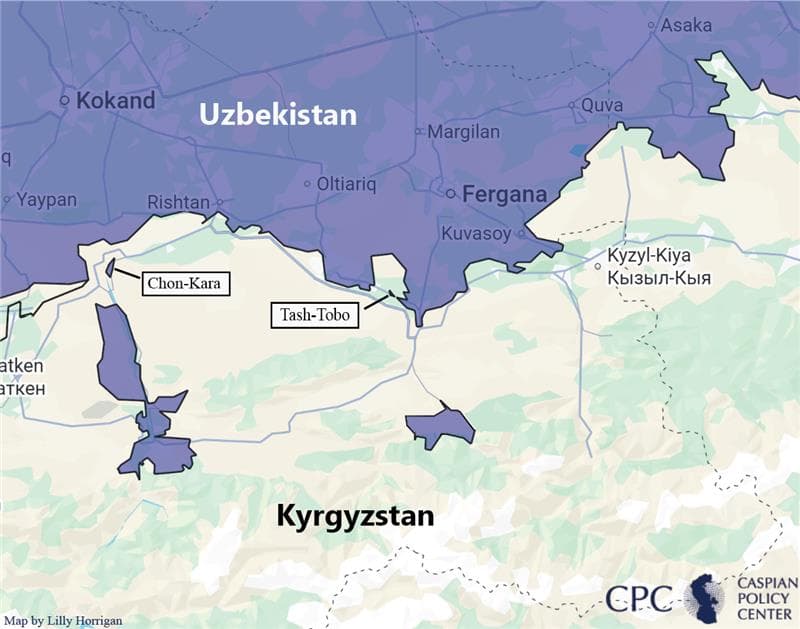
The recent Kyrgyzstan-Uzbekistan border demarcation continues this positive dynamic. Under the agreement, two villages – Chongara and Tash-Tobo – previously administered by Uzbekistan’s Fergana Region, were transferred to Kyrgyzstan. The villages, home to approximately 2,500 ethnic Kyrgyz residents, will be administratively registered before residents receive Kyrgyz citizenship. In exchange, Kyrgyzstan transferred land plots of equivalent size to Uzbekistan along the shared border. The transfer resolves the long-standing issue of two enclaves whose geographic position had complicated local administration, border management, and access to public services.
The agreement also includes a 236-hectare land swap to facilitate the construction of a new road connecting the villages of Sai and Tayan. The road will reduce travel time between Aidarken and Batken from approximately 225 kilometers to just 55 kilometers, significantly improving domestic connectivity in Kyrgyzstan’s Batken Region and eliminating the need for lengthy detours.
Beyond the territorial exchange, the agreement addresses one of the Fergana Valley’s longstanding structural challenges. During the Soviet period, administrative boundaries had enclaves and irregular borders that required residents to cross neighboring states to reach nearby communities. By simplifying sections of the border and improving transport links, the agreement reduces potential friction, facilitates cross-border management, and improves everyday mobility for local populations.
The agreement reflects a broader shift in regional diplomacy – rather than relying on external mediation, Central Asian governments themselves are increasingly resolving complex border disputes through direct bilateral and trilateral negotiations. This growing willingness to address territorial issues through dialogue strengthens regional trust and creates a more stable environment for economic cooperation, trade, and connectivity initiatives.
As Central Asian states demonstrate an increasing capacity to resolve longstanding challenges independently, they become more reliable partners for regional infrastructure projects, investment, and broader efforts to diversify trade routes linking Europe and Asia. The Kyrgyzstan-Uzbekistan border agreement, therefore, shows the continued regional cooperation and contributes to a more stable and interconnected Central Asia. As regional cooperation continues to deepen, this trust will remain an essential foundation for long-term stability, connectivity, and economic development across Central Asia.
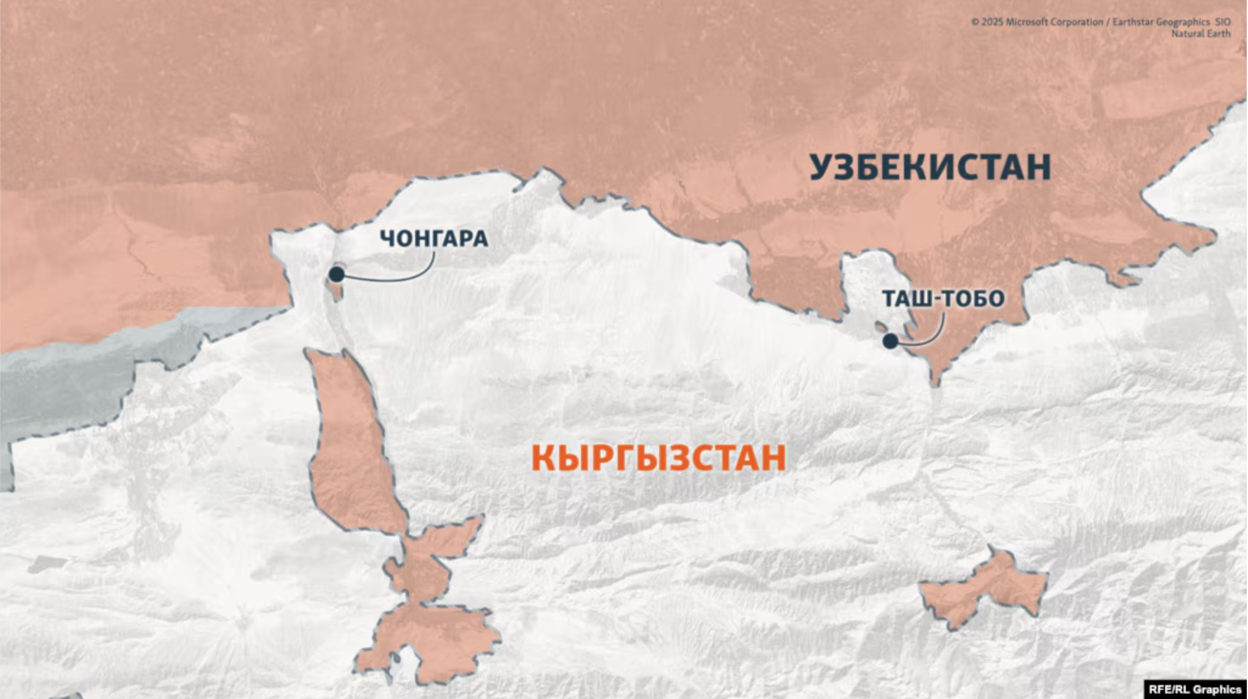
A section of the Uzbek-Kyrgyz border with the transferred settlements
Source: Azattyq Asia