The Organization of Turkic States as a Platform for Cooperation, Not Confrontation
Recent Articles
Author: Erin Malloy
07/16/2026
 The Organization of Turkic States
Western analysts have portrayed the Organization of Turkic States (OTS) as an emerging security coordination platform comparable to the Association of Southeast Asian Nations (ASEAN) that could serve as a new “axis” to counter Russian influence. A specialist in Eurasia and foreign policy at the Hudson Institute stated that “Washington should see the OTS as an increasingly important pole of power that can help dilute the influence of Beijing and Moscow.” Another analyst from the American Foreign Policy Council claimed that OTS activities are “largely complementary to Western policies.”
However, it is unlikely that the Central Asian states are seeking to expand the OTS to become any sort of military alliance. Unlike the Russia-dominated Commonwealth Security Treaty Organization (CSTO), the OTS is not a collective defense organization. In fact, its original charter purposefully shies away from being a security structure, even as it addresses some security-adjacent areas of engagement alongside its cultural vision.
The West’s misattribution of the OTS as a counterpoint to Russia and China highlights the ambiguity of the Organization’s stated purpose. It also treats the Central Asian states as a monolith, oversimplifying their approaches when, in reality, each has taken a different approach to the OTS---each Turkic nation has varying international commitments, foreign policies, and goals that impact their engagement. Representatives of the OTS will likely continue to forcefully assert the Organization’s avoidance of any form of military alliance, even as they pursue security cooperation with Türkiye and each other. At the same time, they will likely have to more definitively assert what the Organization’s purpose is, rather than allowing ambiguity to define its goals for them and weaken their geopolitical position.
Central Asia’s Interactions with the OTS and Türkiye
The level of interest in Turkic cooperation has fluctuated over time and among the Turkic states. While Azerbaijan and Kazakhstan have consistently been enthusiastic participants, Turkmenistan and Uzbekistan have remained more reserved, especially in the security domain. Azerbaijan, Kazakhstan, and Uzbekistan can serve as case studies demonstrating the diversity in levels of security engagement and framing of the OTS that Turkic states have engaged in.
At an October 2025 OTS summit, Azerbaijan President Ilham Aliyev proposed hosting an OTS joint military exercise in 2026, attracting international attention. Aliyev claimed that the OTS has evolved “from a platform for cooperation into one of the significant geopolitical centers,” stressing that “given the current geopolitical and security challenges worldwide, it is crucial that the Turkic states unite as a single center of power.” In October 2025, Azerbaijan participated in a joint military drill with Türkiye in the Caspian Sea, highlighting the decline of Russia’s traditional dominance. Aliyev’s portrayal of the OTS tracks with Azerbaijan’s deteriorating relations with Moscow and its pivot towards strong defense partnership with Turkey in recent years, influencing Western interpretations of the OTS’s goals.
While Kazakhstan has similarly pursued a defense partnership with Türkiye, Astana has been careful to avoid following Azerbaijan’s lead in connecting the brand of OTS with security and defense. Kazakhstan began expanding its military ties with Turkey in 2020 by signing an agreement for joint defense and industrial projects, and has since signed a flurry of agreements for military and intelligence cooperation. Kazakhstan is now Türkiye’s most significant regional partner in overseas drone production, purchasing Turkish UAVs and producing them domestically. In May 2026, Erdogan signed a joint agreement to expand Kazakhstan’s production of Turkish ANKA drones.
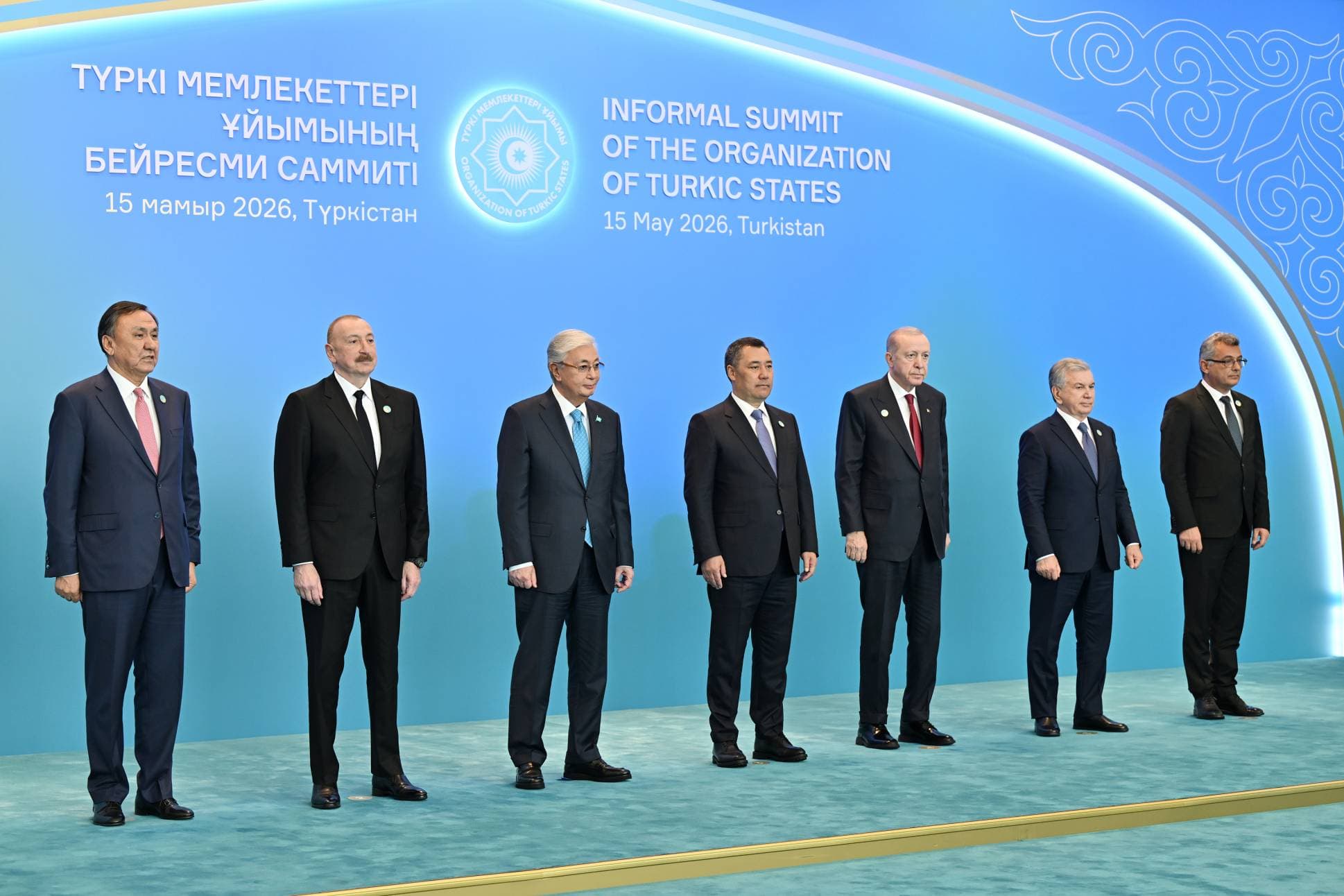
However, while Kazakhstan will likely continue to pursue bilateral defense engagement with Türkiye, its official position is that the OTS is not evolving into any kind of geopolitical military alliance. At the most recent OTS summit on May 15, 2026, Kazakhstan President Tokayev asserted that the OTS is not evolving into a geopolitical or military alliance—instead, it is focused on unifying the Turkic world and expanding economic, technological, and cultural collaboration. He claimed that framing the OTS as a military alliance is misguided and aimed at creating division, a nod to the risk the Central Asian states would face if they positioned themselves against Moscow or Beijing. The OTS website press release covering the summit, which was themed “Artificial Intelligence and Digital Development,” also makes no mention of security initiatives.
Uzbekistan has similarly pursued defense ties with Türkiye through bilateral channels, while viewing the OTS as a forum to address a broad range of critical economic and cultural issues rather than a primarily security-focused organization. Uzbekistan began pursuing security and military cooperation with Turkey years before the Organization of Turkic States rebranded and started addressing security issues. In 2017, Türkiye and Uzbekistan signed a protocol on military education cooperation and began sending Uzbek officers to Turkish military academies. Joint military exercises soon followed.
The defense partnership between Uzbekistan and Türkiye continues today. In May 2026, Türkiye announced it would send a military advisory group to Uzbekistan to support armed forces reform, paralleling Türkiye’s military cooperation with Azerbaijan. Uzbekistan is also undertaking a process to replace Russian language military terms with Uzbek equivalents.
Overall, Uzbekistan’s leadership in the Organization seems to be prioritizing political and economic initiatives equally with security initiatives. President Mirziyoyev’s security cooperation initiatives have focused on cyber threats, violent extremism, and cross-border challenges through intelligence-sharing and capacity-building. As Uzbekistan shares a border with Afghanistan, Tashkent has also maintained diplomatic ties with Kabul and worked to position itself as a mediator for regional stability, complementing OTS’s broader security objectives. However, Uzbekistan’s security priorities do not amount to engaging with the OTS as a military alliance or emerging defense bloc.
Why the West’s interpretation of the OTS is Wrong
Turkic states in Central Asia today are all in some way engaging with Türkiye in security, intelligence, and defense spheres—whether that be through military education exchanges, training and exercises, equipment and technology trading, or the development of common operational approaches and doctrine. However, they are still operating with a multi-vector approach to engagements with foreign powers, maintaining partnerships with the West, China, and Russia at once.
The idea of the Central Asian states and Türkiye expanding the OTS to become a military alliance that seeks to push out Russian or Chinese influence in the region is unlikely. Such a pivot would harm their relations with Moscow and Beijing, which have already taken steps to stem the proliferation of a pan-Turkic identity. Security cooperation will more likely remain one facet of the Organization’s many areas of cooperation.
Why the OTS is Still Valuable
At the same time, the Central Asian states still view the OTS as a valuable platform and will have intensified their engagement in recent years for several reasons.
First, the OTS is attractive to Central Asia because it is not dominated by a great power outside of the Turkic States. The overall security architecture of the Central Asian countries is complex: while Turkey is a member of NATO, Kazakhstan and Kyrgyzstan are members of the Russia-dominated Collective Security Treaty Organization (CSTO), which Moscow has used to promote its own interests in the region. Four of the five Central Asian states are members of the Shanghai Cooperation Organization (SCO), which has facilitated Russia-China cooperation in the region. Central Asian states are also oriented towards the West, with all five countries participating in the Organization for Security and Cooperation in Europe (OSCE). The OTS thus allows Central Asian countries to operate in accordance with their own foreign policies, without disturbing their alliances or being overshadowed by Russian or Chinese influence. That said, a member’s existing commitments to other organizations may affect the extent to which they engage with the OTS and how they publicly frame the OTS’s goals.
Second, the OTS offers an additional forum to supplement the region’s interlocking security architecture to enhance their overall stability. The West has relied on an interlocking security architecture since the end of World War II, composed of international organizations like NATO, the EU, and the OSCE. The Central Asian states, especially considering their varying financial capacities and existing commitments to international organizations, likely view the OTS as one more effective platform for collaboration across all issue areas.
The OTS’s pivot towards the security, defense, and intelligence industries is striking. However, overstating this change from the perspective of U.S. foreign policy goals has the potential to harm Central Asian states’ relations with their neighbors, and misrepresents what the OTS really does. From the start, it was a cultural platform to unify the Turkic states and facilitate economic and political cooperation. Bilateral security initiatives between Turkey and Central Asian states have been pursued outside the OTS, both in response to changing geopolitical threats and to reduce dependencies on Russia and China. Thus, the OTS including security on its long menu of initiatives does not necessarily suggest a major adversarial shift by Central Asian states to become an ‘axis’ in opposition to Russia or China.