Trans-Caspian Links: The Growing Investment Portfolio Between Azerbaijan and Uzbekistan
Recent Articles
Author: Kurtis Yan
09/03/2026
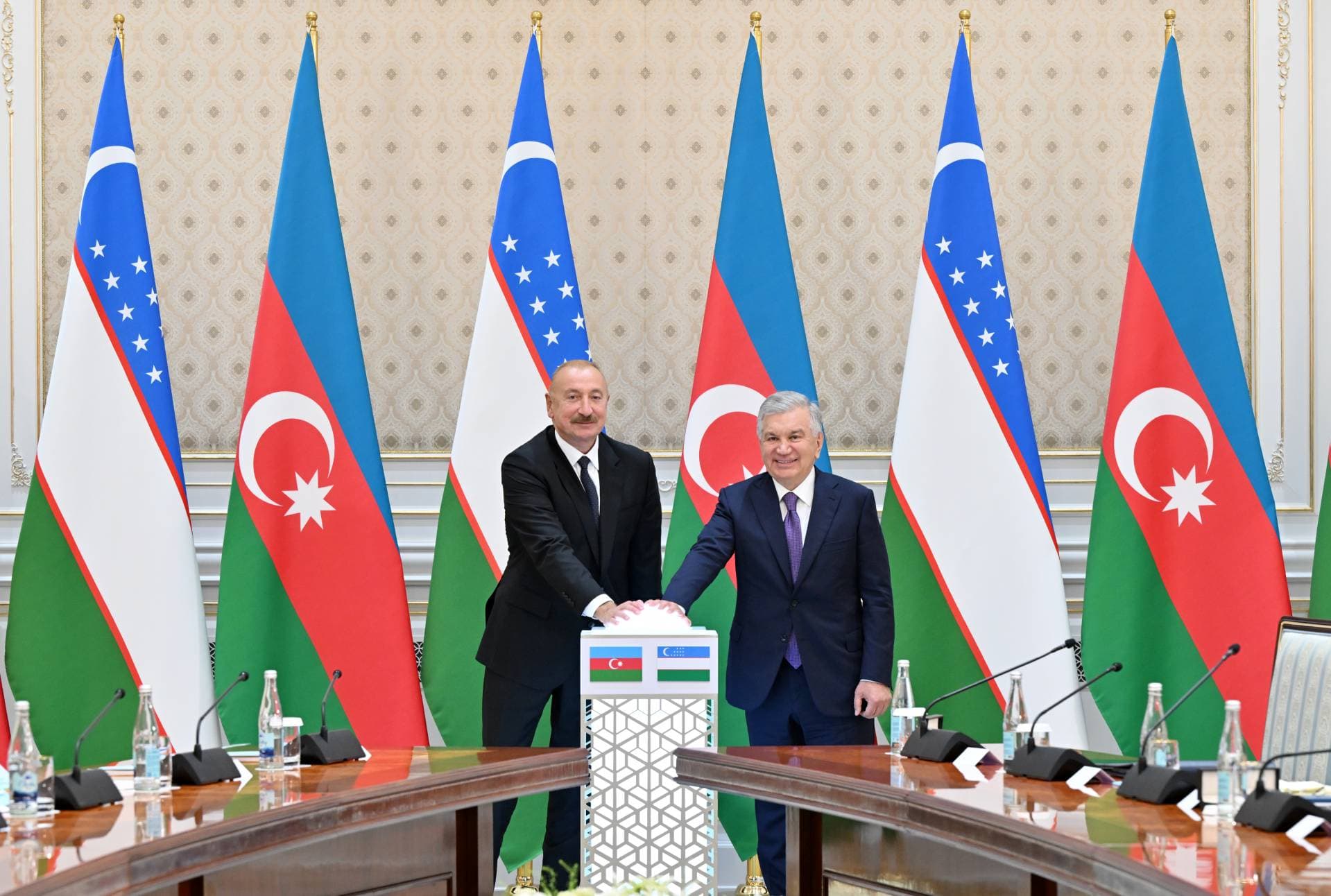
Cooperation between Azerbaijan and Uzbekistan remains vital as the two sides look to bolster trans-Caspian relations. Talks in Tashkent between Uzbekistan’s President Shavkat Mirziyoyev and Azerbaijan’s President Ilham Aliyev on August 23 signal that both parties are committed to broader economic cooperation. Recent investment plans targeting energy cooperation and regional connectivity will be key to improving intraregional relations and political influence of the Greater Caspian Region.
Investment at the Heart of Bilateral Relations
The primary takeaway from the discussions between Mirziyoyev and Aliyev was the growth and facilitation of joint investment initiatives. In Tashkent, both leaders participated in the third Supreme Interstate Council—a heads-of-state level platform for their countries to coordinate virtually all issues, from security and economy affairs to strategic cooperation. This mechanism also allows both sides to introduce new projects and track the implementation of current ones.
Joint projects receive funding through the Azerbaijan Uzbek Investment Company (AUIC). With authorized capital of over $500M, it provides a strong funding base for new initiatives. The investment horizon for projects is five to eight years. At the same time, Aliyev stated that the current portfolio of Azerbaijan-Uzbekistan projects already exceeds $500M.
The AUIC’s footprint spans a range of economic sectors. For example, AUIC, Azerbaijan’s AzerGold CJSC, and Uzbekistan’s Uzbek Geological Exploration JSC signed an agreement on July 17 for a joint exploration venture in Uzbekistan. Likewise, AUIC states that it has invested $15M into retail-store supply chains, along with $1.7M into computing infrastructure, including advanced data centers with cooling technologies for artificial intelligence (AI). AUIC also invested $2M in the American University of Technology in Tashkent.
Beyond AUIC, there are many examples of private investment and business cooperation. During Aliyev’s visit, the State Oil Company of Azerbaijan (SOCAR) announced the opening of five new retail filling stations. Moreover, demonstrating the diversity of trans-Caspian investment beyond extractive sectors, Azerbaijani company Agalarov Development plans to construct Sea Breeze Uzbekistan, a residential complex and tourism site in Uzbekistan that Tashkent estimates will be a $5B investment.
Boosting Trade and Connectivity
The two sides also established a new bilateral trade target of $1B by 2030. According to Uzbekistan’s Ministry of Investment, Industry, and Trade, Uzbekistan and Azerbaijan increased their trade by roughly 14.6 percent from 2024 to 2025, with a 2025 total at around $307.2M.
To bolster trans-Caspian connectivity, both states are aiming to develop a joint fleet to streamline loading procedures and reduce logistical bottlenecks at Caspian Sea ports. With roughly 1.4 million tons of freight between Azerbaijan and Uzbekistan in 2025, an expanded and more coordinated fleet could contribute to the Middle Corridor’s overall capacity and efficiency. Uzbekistan also aims to integrate the China-Kyrgyzstan-Uzbekistan railway with existing routes to bolster the corridor transit network. In addition, officials announced plans to increase weekly air travel between the two countries from 18 to 40 flights.
Prospects for Further Cooperation
Uzbekistan and Azerbaijan recognize the growing importance of the Greater Caspian Region as a political bloc amidst instability to the region’s north and south. Aliyev emphasized that trans-Caspian connectivity is achievable by viewing Azerbaijan and Central Asia as a unified geoeconomic region. As the Russia-Ukraine War continues to stifle transit along the Northern Corridor because of international sanctions against Russia, both states recognize the importance of regional cohesion to increase freight along the Middle Corridor, attract foreign investment, and bolster the region’s geopolitical autonomy.
Meanwhile, SOCAR’s international footprint is also growing, becoming a more integral force across Central Asia and Europe. Most notably, SOCAR is leading a $2B project with Uzbekneftegaz and British Petroleum to develop oil and gas resources in six blocks of Uzbekistan’s Ustyurt plateau, with seismic data analysis currently underway and expected to be completed early in 2027. SOCAR also continues to strengthen its relations with European Union countries and expand its presence in European refining.
The impacts of the Russia-Ukraine War and the U.S.-Iran War are apparent across global energy markets, and the fuel and oil crises definitely affect the Central Asian states. But these conflicts also reinforce the importance of the Greater Caspian Region as a stable energy producer and hydrocarbon supplier. As such, intraregional and trans-Caspian investment projects might be essential to improving the region’s overall energy security and influence as an exporter in global energy markets. Expanding this cooperation can help solidify the breadth and reliability of the region’s logistical gateway and unlock further access to Western markets.