Can the Middle Corridor Outrun Climate Change? The Caspian Sea’s Challenge to Eurasian Connectivity
Recent Articles
Author: Aigerim Orynbassar
07/31/2026
 Prangel et al
Discussions of the Middle Corridor often focus on geopolitics, infrastructure investment, and customs harmonization. But the biggest long-term constraint might be physical geography: if the Caspian Sea continues to shrink, can the corridor still scale up cargo volumes?
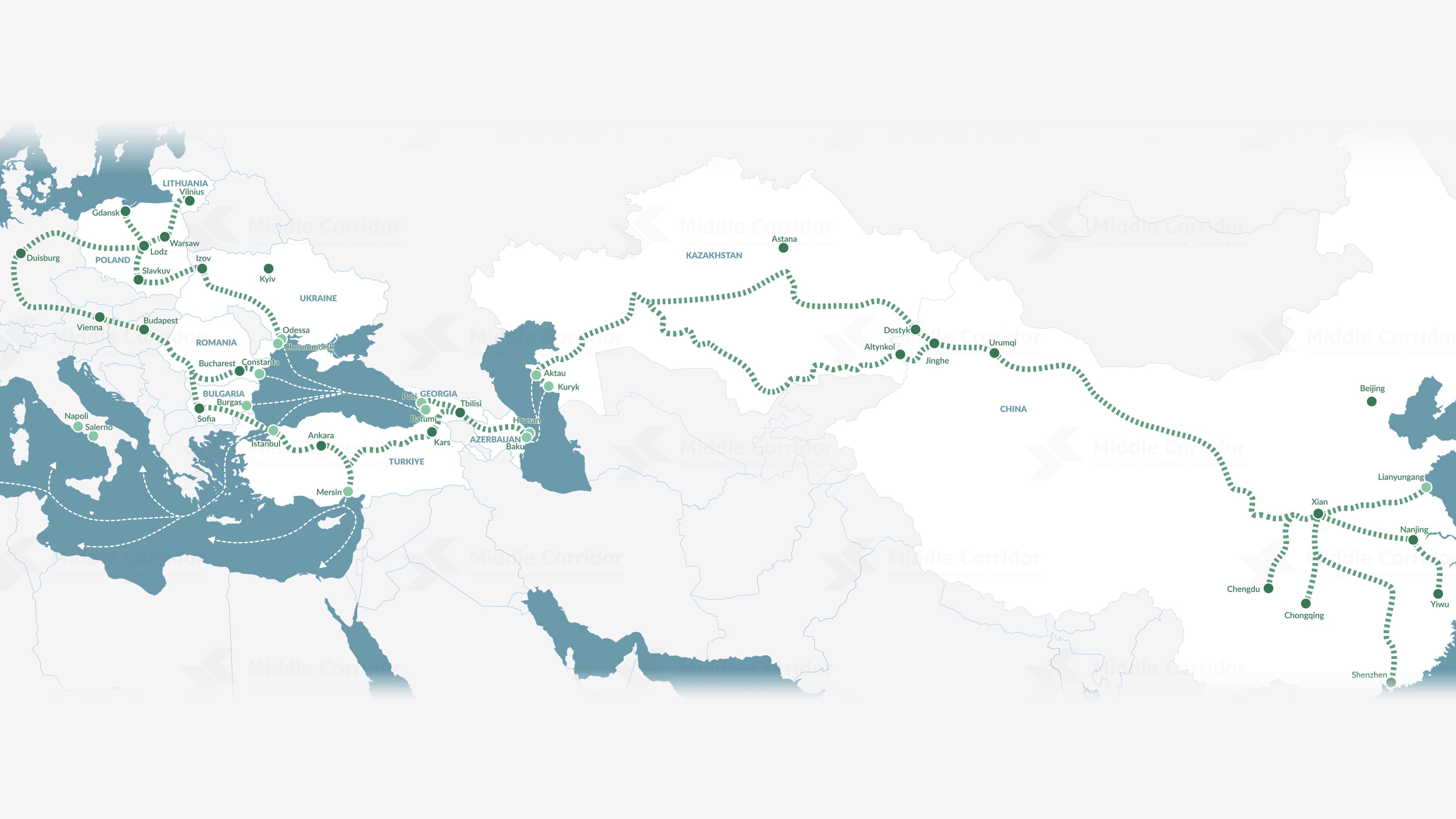
Since the beginning of the war in Ukraine, the Middle Corridor has gained strategic importance for the Caspian region, the European Union, and China as an alternative to the Northern Corridor that passes through Russia. As governments and businesses looked for alternative Eurasian trade routes after 2022, cargo volumes increased. Freight volumes increased from about 0.6-0.8 million tons annually in 2019-2021 to more than 4.5 million tons in 2024, while container traffic rose by around 260% to approximately 50,500 twenty-foot equivalent units (TEUs).
In November 2022, Azerbaijan, Georgia, and Kazakhstan agreed to strengthen cooperation to make the route faster, more interconnected, and more competitive. With trade between the European Union and China expected to increase by 30%, policymakers on both sides of the Caspian view the corridor as a critical component of Eurasian connectivity. However, as cargo volumes rise, the route faces a serious challenge – the declining water level of the Caspian Sea.
A Shrinking Caspian Sea
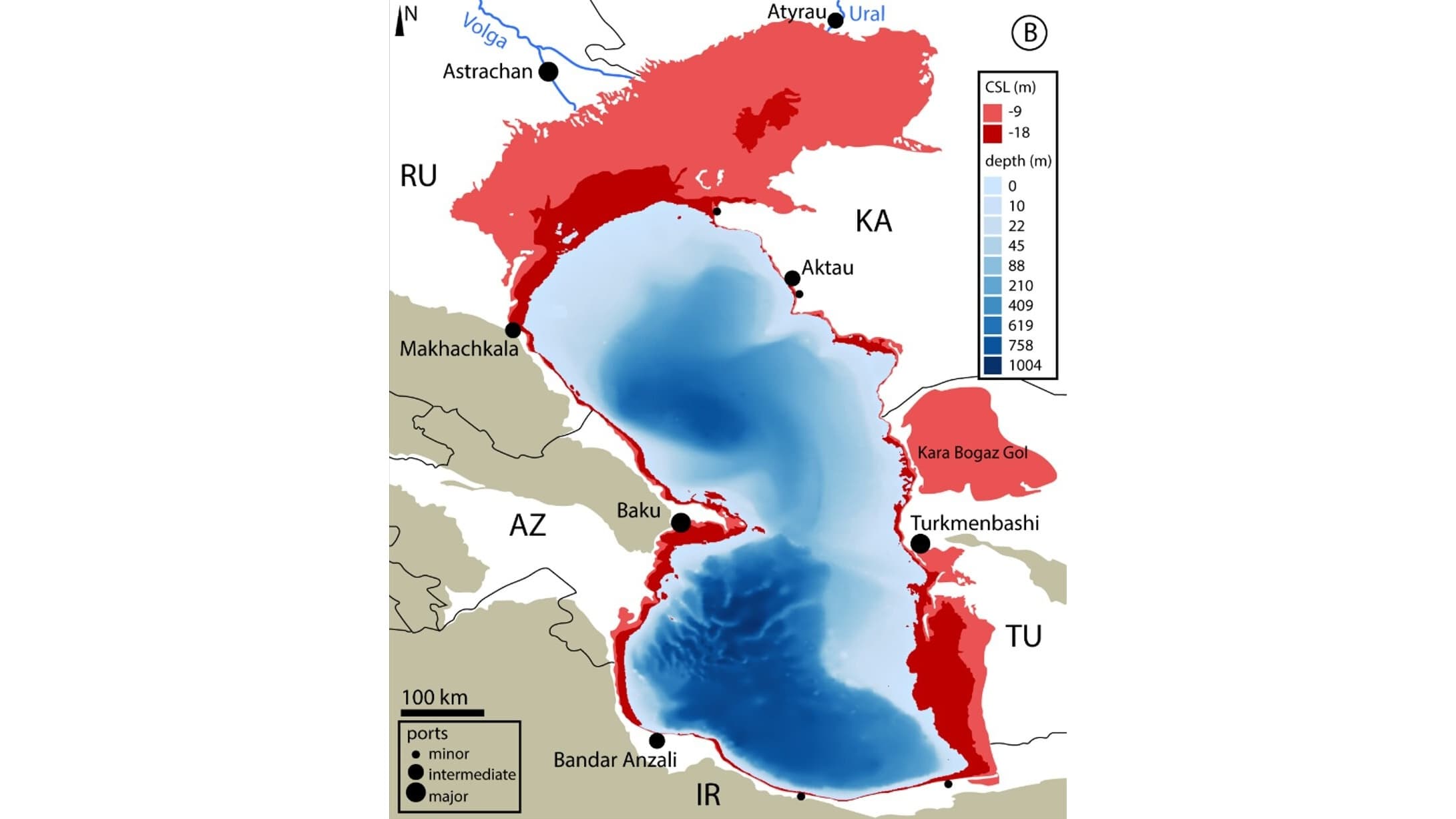
Over the past five years, the Caspian Sea’s water level has fallen by more than half a meter. The main reason is climate change, which has reduced freshwater inflows from the Volga and Ural rivers. At the same time, extensive agricultural water consumption – up to 90% is used for irrigation – across the region puts more pressure on already stressed water resources.
The environmental consequences are becoming increasingly visible. At the beginning of the 21st century, the northeastern section of the Caspian Sea covered more than 15,000 square kilometers. By October 2024, that area had shrunk by nearly 46% to 8,183 square kilometers, while the coastline retreated by approximately 56 kilometers compared to 2001. Current projections suggest that the decline will continue. According to Kazhydromet, under an optimistic scenario, the Caspian Sea could fall by 3-4 meters by 2050.
Ports Under Pressure
The effects are already being felt across the region’s transport infrastructure. Falling water levels have disrupted operations at key Caspian ports, including Kuryk in Kazakhstan and Turkmenbashi in Turkmenistan. Ferry transportation of railway tank cars decreased by 22% and wagon transportation by 10% on some routes. There are similar challenges on the Baku-Turkmenbashi route, where ferry transportation of railway tanks fell by 37% and wagon traffic by 19%.
Declining water levels are also increasing operational costs. At the Port of Aktau, re-berthing a grain vessel can cost about one million tenge, while annual dredging expenses cost around 400 million tenge. In some cases, vessels can be loaded to only 75-80% of capacity because of shallow waters, reducing transport efficiency and increasing costs across the corridor.
From Environmental Challenge to Infrastructure Risk
The shrinking Caspian Sea should no longer be viewed solely as an environmental issue. It is also a strategic infrastructure challenge with impacts on the future of the Middle Corridor. Kazakhstan has already responded with dredging and port modernization projects – more than 1.7 million cubic meters of soil have already been removed at Kuryk, increasing operational depth to 8.5 meters, while Aktau is being deepened to approximately 7.7 meters. These measures alone are unlikely to provide a lasting solution. Investments are essential, but they might not work if water levels continue to decline.
Since the Caspian’s water levels have already fallen by about two meters since 2006 and are projected to continue declining, coordinated planning could help reduce operational disruptions and prevent costly, uncoordinated responses. One possible framework already exists – the Tehran Convention, the first legally binding environmental agreement among the five Caspian littoral states: Kazakhstan, Azerbaijan, Iran, Russia, and Turkmenistan. This agreement promotes environmental monitoring, information sharing, and cooperation on transboundary challenges. Building on this framework, the Caspian states could establish a joint monitoring and forecasting mechanism for maritime transport, enabling ports and shipping operators to share hydrological data, climate projections, and navigation forecasts.
The success of the Aktau Protocol, adopted in 2011 and that entered into force in 2016, after ratification by all five states, shows that regional cooperation on shared risks is possible. Originally designed to coordinate in response to oil pollution incidents, the protocol provides an example of how common challenges can be addressed through collective action.
Looking Ahead
The long-term success of the Middle Corridor might depend as much on climate adaptation and water governance as on rail connections, port expansion, and diplomatic agreements. As the Caspian Sea continues to decline, maintaining navigability will require not only solutions but also regional cooperation. If the Caspian states can successfully coordinate adaptation efforts, they will not only protect maritime transport but will also strengthen one of Eurasia’s most important emerging trade routes.