Europe - Caspian Briefing, September 8 , 2026
Recent Articles
Author: Caspian Policy Center
09/08/2026
Energy and Economy
EU Backs Temporary Trade Measures to Support Armenia
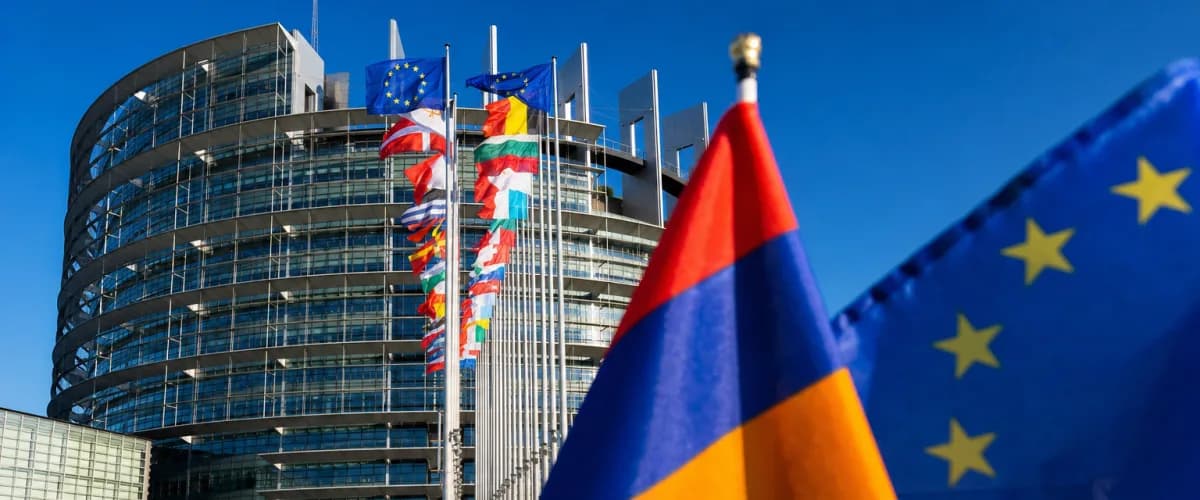
The Council of the European Union (EU) agreed on 2 September to introduce temporary trade-liberalisation measures for Armenian products, liberalising around 80 percent of Armenia's exports to the EU in response to trade restrictions Russia recently imposed on Armenia. The measures suspend import duties for two years on a broad range of goods, including nearly 99 percent of Armenia's fresh fruit, vegetable and plant exports and over 91 percent of beverages and spirits, with safeguard measures to protect EU producers if imports surge. The regulation is intended to reinforce EU-Armenia trade relations under the Comprehensive and Enhanced Partnership Agreement (CEPA). The European Parliament is expected to formally adopt its position in its September plenary session before the Council finalises the regulation.
Source: Council of the European Union
Uzbekistan's Centrum Holding Considers London Stock Exchange for $2 Billion IPO
Uzbek logistics conglomerate Centrum Holding plans to conduct an initial public offering in the first quarter of 2027, with the London Stock Exchange identified as its primary prospective listing venue. The company is targeting a valuation of approximately $2 billion and could raise around $600 million by floating a 30 percent stake, with Oppenheimer and Citibank advising on the IPO process. Centrum Holding, which operates cargo and passenger airlines alongside rail, logistics and port assets, reported $1 billion in revenue in 2025 and plans significant expansion of its aircraft fleet and logistics operations. The prospective London listing would support the group's efforts to attract international investment and expand its role in transport links between Europe and Asia, including along the Middle Corridor.
Source: UzDaily
DP World to Begin Construction of $288 Million Tashkent Dry Port
UAE-based logistics giant DP World will begin construction in October on a $288 million multimodal terminal in Tashkent, an 82-hectare site combining rail, road, customs and warehouse infrastructure intended to cut logistics costs in double-landlocked Uzbekistan. The first phase includes a rail terminal with 150,000 TEU annual capacity. DP World holds an 85 percent stake alongside city-owned Tashkent Invest. The project sits alongside Uzbekistan's wider push for outbound freight capacity, including growing use of Kazakhstan's Caspian ports (Uzbek freight through Aktau and Kuryk rose over 60 percent in 2025) connecting onward via the Middle Corridor toward the South Caucasus, Türkiye and Europe.
Source: The Times of Central Asia
Uzbekistan Labor Migration Looks to New Markets in Europe and Asia
Uzbekistan's Central Bank said ageing populations and economic changes are creating new job opportunities for Uzbek workers in Europe, Asia and the Gulf through 2030. Europe could face a shortage of 7.5 - 10.5 million workers, especially in healthcare, engineering, IT and green energy. Germany alone needs around 400,000 skilled migrants a year, plus hundreds of thousands more in elderly care and renewable energy, while the UK could need roughly 90,000 additional care workers. Japan, South Korea and Gulf states like Saudi Arabia and the UAE are also expected to need millions more workers as their economies grow and change. Around 1.4 million Uzbeks currently work abroad across nearly 40 countries, and while Russia remains the biggest destination, more are now heading to Europe and Asia. UK money transfers to Uzbekistan rose 62 percent in the first half of 2026, and EU transfers rose 27 percent.
Source: The Times of Central Asia, Daryo.uz
Austria-Kazakhstan Platform Seeks to Advance Middle Corridor Development
The Austrian-Kazakh Connectivity Platform (AKCP) convened around 50 representatives from government, diplomacy and business at the European Forum Alpbach to discuss the next phase of Middle Corridor development. Participants focused on translating political commitments into commercially viable projects by reducing transit times, improving port and rail capacity and digitalising cross-border customs procedures. The AKCP, launched in Austria's Parliament in July, aims to connect Austrian expertise in rail, infrastructure, energy and industrial technologies with projects along the corridor. World Bank projections cited at the meeting suggest targeted investment could halve transit times and triple freight volumes to around 11 million tonnes annually by 2030.
Source: Vindobona
After CPC Disruptions, Kazakhstan Wants to Refine More Oil at Home
Kazakhstan plans to more than double domestic oil refining capacity to 40 million tonnes by 2033, accelerating an earlier 2040 target, after Energy Minister Yerlan Akkenzhenov said attacks on CPC infrastructure had cost around 3.5 million tonnes of production and forced a cut to the 2026 output forecast from 98 to 96 million tonnes. Kazakhstan produced 99.6 million tonnes of oil in 2025 but refined only 18.4 million tonnes. A fourth major refinery (up to 10 million tonnes/year capacity) is planned, with a site to be chosen by year-end. Akkenzhenov also named the underused Baku-Supsa pipeline through Georgia as a "vital" alternative route, though no direct talks with Azerbaijan have yet taken place, while Kazakhstan already ships around 1.2 million tonnes a year via the Baku-Tbilisi-Ceyhan pipeline with plans to increase this to 2.2 million tonnes.
Source: The Times of Central Asia
EBRD Backs Kazakhstan's Grid Modernisation and Agricultural Exports
The European Bank for Reconstruction and Development (EBRD) is lending up to €25 million to TradeAgra and affiliated companies within Kazakhstan's TBF Holding Group, one of the country's leading privately owned agricultural commodity traders, to provide seasonal working capital for procurement, processing, storage, transport and export of agricultural commodities. The loan is supported by a €500,000 investment grant under the EBRD's Agrifood Nexus programme, funded by Germany through its International Climate Initiative, aimed at growing organic crop exports while reducing fertiliser and water use; accompanying technical cooperation will fund training for company staff and supplier farmers, with targeted outreach to women farmers. The EBRD is also lending up to €194 million to Alatau Zharyk Company, a regional electricity distributor supplying around 4 million people and 50,000 businesses in the Almaty region, to fund automated metering, smart-grid technology and low- and medium-voltage infrastructure upgrades under Kazakhstan's National Project for Energy and Utility Modernisation. The EBRD has now invested more than €11.7 billion in Kazakhstan across 358 projects, making it the bank's largest and longest-running country of operation in Central Asia.
Source: European Bank for Reconstruction and Development, Daryo.uz
Azerbaijan to Launch Two Green Energy Corridors From 2032
Speaking at the opening of Baku Climate Week 2026, Azerbaijan's Energy Minister Parviz Shahbazov said the country will begin operating two green energy export corridors from 2032: the first phase of the Caspian-Black Sea-Europe Green Energy Corridor and the Central Asia-Azerbaijan Green Energy Corridor. Shahbazov said Azerbaijan is also taking concrete steps to develop further green energy links toward Türkiye and Europe via Georgia, the Zangezur Corridor and Nakhchivan, framing the diversified network as a way to strengthen regional energy security and cut emissions beyond Azerbaijan's own borders. He also referenced the upcoming COP31 in Türkiye, saying Azerbaijan intends to build on its COP29 legacy by turning the energy transition agenda into "concrete projects" and regional connectivity.
Source: Trend.az
Germany to Hold Energy Trade Mission in Baku, Azerbaijan Courts German Green Finance
An Energy Trade Mission featuring German companies will be held in Baku on 7-10 December under the German Energy Export Promotion Initiative, following a webinar in which German and Azerbaijani officials discussed grid modernisation, e-mobility and renewable storage. Separately, Germany's export credit agency Allianz Trade said it is ready to finance Azerbaijani renewable energy projects without fixed volume limits, offering extended 22-year repayment terms (versus the standard 15) and a reduced "German content" threshold of 30 percent (versus 51 percent) for green projects, as part of continued follow-through on the Azerbaijan-Germany strategic partnership signed in Berlin in July.
Source: AHK Azerbaijan, Report.az
UK Geophysical Firm Metatek Wins New Azerbaijan Contracts
UK-based Metatek-Group has secured two new airborne survey contracts in Azerbaijan to support oil and gas exploration, including a major follow-up project for state oil company SOCAR that expands coverage from around 3,600 to roughly 20,000 square kilometres west of Baku. The expansion builds on a 2025 pilot project that successfully tested new aerial survey technology in an area whose difficult underground geology has historically made it hard to explore using conventional methods. Metatek has also won a separate contract with Canadian firm Gran Tierra Energy, expected to run later this year. The surveys use aircraft-mounted sensors to map what lies beneath the surface, helping identify areas with potential for future oil and gas discoveries.
Source: Caliber.Az, Metatek
Politics and Security
Mirziyoyev Travels to Serbia for Official Visit
Uzbek President Shavkat Mirziyoyev is visiting Serbia on 7 - 8 September for talks with Serbian President Aleksandar Vučić aimed at strengthening bilateral trade, investment and economic cooperation. The two sides are expected to discuss joint projects in transport, mechanical engineering, light and food industries, agriculture, pharmaceuticals and information technology, alongside cooperation on organised labour migration and stronger regional and cultural ties. A bilateral business forum will also bring together government and private-sector representatives, while the summit is expected to conclude with a package of intergovernmental and interdepartmental agreements.
Pashinyan Places TRIPP Implementation at Center of Armenia’s Government Program
Armenian Prime Minister Nikol Pashinyan identified implementation of the Trump Route for International Peace and Prosperity (TRIPP) as a priority of his government’s 2026–2031 program. Pashinyan emphasised that the route will operate on Armenian territory and under Armenian sovereignty, territorial integrity and jurisdiction. The project is intended to establish a new east-west transportation connection through Armenia linking Azerbaijan and Nakhchivan and potentially connecting Central Asia with Türkiye and European markets. Its implementation could significantly alter the geography of the Middle Corridor.
Source: Public Radio of Armenia
Pashinyan and Putin Clash Over Armenia's EU Aspirations, Agree to Continue Talks in Moscow
Armenian PM Nikol Pashinyan and Russian President Vladimir Putin openly clashed over Armenia's EU aspirations at the SCO summit in Kyrgyzstan on 1 September, their first meeting since Armenia's June elections. Putin pressed Armenia to hold a referendum choosing between the EU and the Russia-led Eurasian Economic Union (EAEU), arguing that Armenia's law initiating EU membership talks already amounted to a de facto EAEU exit, while stressing Russia remains Armenia's largest trade partner. Pashinyan pushed back, saying no formal withdrawal notice had been submitted and a referendum was not yet "mature enough," noting the regional picture had changed now that peace with Azerbaijan is largely established. Despite the disagreement, both leaders agreed to continue talks during a planned Pashinyan visit to Moscow, with Putin also reiterating Russia's readiness to withdraw its military base from Armenia if requested.
Source: OC Media